Wednesday, October 28, 2009

Electric Cars: Transformational Change or Niche Trend?

The GABA event on electric vehicles on October 12th at Cooley’s in Palo attracted an audience of nearly 100 people. GABA Automotive Industry Group Chair Thilo Koslowski presented  his Electric Vehicle analysis from Gartner, and moderated a panel of representatives from Better Place, Coulomb Technologies, General Motors, and AC Propulsion who exchanged their views on developments in the emerging electric vehicle industry.
 
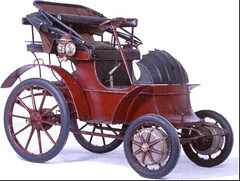
Early electric vehicle: Lohner-Porsche from the year 1900


Thilo Koslowski, vice president and automotive practice leader at Gartner, disclosed numbers predicting that in industrialized automotive markets, battery-powered vehicles (plug-in full-electric and plug-in hybrid electric vehicles) will represent 5 to 8 percent of all vehicles sold using various types of propulsion technologies by 2020. Battery-powered vehicles will account for 15 to 20 percent of all vehicle sales by 2030.

According to Thilo’s analysis three key factors will impact EV adoption over the next years:

Automotive Industry and Technology Advancements
To test EV market acceptance and prepare for a potential boost in EV production, virtually all global mainstream automobile manufacturers are planning to bring at least one EV model to market in the next four years; some plan to do so even sooner. The growth in EVs is also opening the door to emerging vehicle manufacturers that specialize in the design, development and sale of battery-powered automobiles. Furthermore, the emergence of new supply chain partners that provide engineering, powertrain components, testing and battery offerings continues.

At the same time, key technological advancements are prerequisites for creating dependable battery-powered vehicles in the future and include:
-    Increased energy density for various chemical compositions in EV batteries and new powertrain designs with increased reliability
-    Advanced software control models (e.g., for energy, battery and temperature management)
-    Expanded standardization efforts, such as the SAE J1772 initiative for standardizing EV charging plugs, which is likely to be adopted by most OEMs this year

EV Infrastructure Developments
 Infrastructure developments require massive investments to provide users with a seamless transportation experience for battery-powered vehicles. To this end, infrastructure efforts need to accomplish new forms of collaboration between vehicle manufacturers, energy providers, charging service providers and vehicle owners. Gartner predicts that EV brokers will play a critical role in achieving this required collaboration aimed at simplifying EV ownership, but brokers' business models will need to adapt to a changing value chain over the next five years.

Societal and Political Trends
Consumer awareness about the operational costs of passenger vehicle ownership and the desire to meet environmental objectives has grown steadily in developed countries over the last three years in response to rising awareness about global warming, higher fuel costs and vehicle emissions. At the same time, regional governments have also increased their financial support for EV development.

Additional information is available in the Gartner report "The Electric Vehicle's Value Chain and Technology Evolution" at http://www.gartner.com/DisplayDocument?ref=g_search&id=1179817&subref=simplesearch

Sunday, September 27, 2009

Phone Wars and the Current Challenges Wireless Semiconductor Manufacturers Are Facing

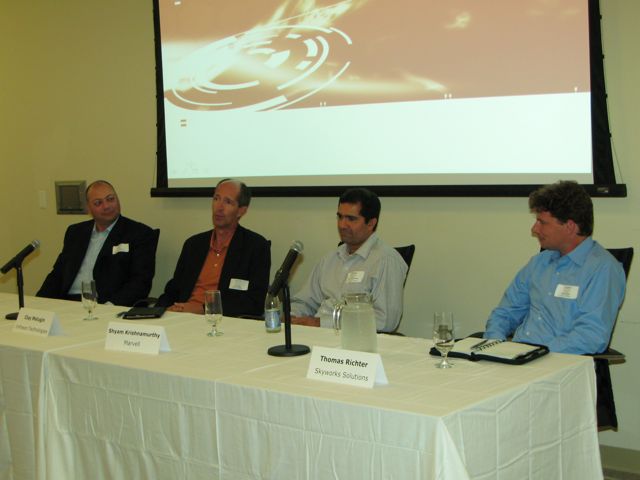
The trend towards the Smart Phone cannot be stopped anymore, the participants of the GABA Semiconductor IG event on September 17th, 2009 agreed.

Technology is converging, and people are using their phones for all sorts of applications, many of which had been exclusive of the PC world before. The application fields go way beyond simple web browsing. However, Smart Phones will not see as much single chip integration as ultra low-cost phones. Even though integration will advance, multi-chip solutions remain more cost effective and flexible in most cases. This is especially true, when looking at the different innovation speed in the areas of modem and application processor.


A question that brought up some controversy among the panelists was, whether the Smart Phone of the future will resemble a PC platform: Some argued that there would be little room for differentiation and all devices will provide ample performance to use with any given application, which will lead to faster pace towards commoditization and result in lower margins on the hardware side. Others were confident that there would be enough room for them to differentiate their products to keep up the current pace of innovation and the correspondent product replacement cycles.


Patents remain another threat for Hardware Manufacturers. For the upcoming 4G wireless technology standards, it is not yet clear whether this will turn out to be as much a minefield as it has been for the current 3G technology. In the past, patent officers often granted patents containing only little innovation, which led to many lawsuits regarding wireless technologies. Tarek Fahmi, Partner and Semiconductor IP and Patent Counsel at Sonnenschein Nath & Rosenthal LLP, said he received the impression that patent courts are currently making it harder for patent trolls to obtain license payments or prevent competitors from shipping their goods only because they are holding a patent.


In the future, however, core fields of innovation might shift away from the semiconductors towards other key components of the mobile phone such as the touch screen displays and the battery. Arbitrary battery form factors and more capacity will fuel longer phone run time without sacrificing attractive designs.

All parties agree that the battle around mobile phone software platforms is just beginning. Stay tuned for the next event on Phone Wars when we will be exploring a similar topic with software industry experts.

Slides from the presentation at the event are available at http://www.gaba-network.org/download/090917_GABA_Phone_Wars_I.pdf

Best regards
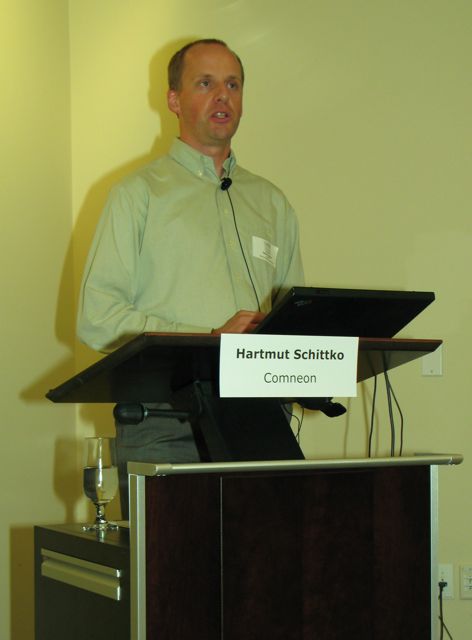
Hartmut Schittko

Tuesday, September 8, 2009

Who You Know, Who Do They Know, And How Will You Be Perceived?

We are in the early stages of the Social Networking revolution. It may seem that this revolution started recently with sites like LinkedIn, Facebook, and Twitter. In fact, the revolution started initially in the dotcom era with dating sites (match.com, yahoo personals…) and reconnection sites (classmates.com, Ancestry.com…). These sites, all of which I have used in the past, laid the foundation for the Social Networking revolution we are experiencing today.


It simple to join any Social Network and many times “free.” It seems like all you need to do is add the required information and you are part of the network. Do not be deceived by the simplicity; there is much more thought that needs to go into what you say and what you add to your Social Networks.

Many people see Social Networking as another fad that will fall apart over time or something they do not need to understand because it will not affect the way they do business or even a big waste of time. Wrong! In 2008, 22% of employers used Social Networking to do background checks. By 2010, the projection is over 55% will be using Social networking for background checks. I believe that the estimate is conservative.


From the perspective of a job searcher, Social Networks make it easier for potential employees to research companies and potential bosses. Reading the recommendations or lack thereof tells you a lot about a person and gives you “interesting” information on their management style or lack thereof. You do not know who your friend’s friend’s friend is and what they do. If you are looking for a job, it is imperative that you utilize Social Networking, both in person and on the web. Your competition, for any posted job is already using both methods. Additionally, there are techniques to use Social Networking to project where a new job might be.


When I received the email request to do a guest blog for GABA, I was both honored and wondered who was making this request. As a Social Networking expert, I like to know as much as I can about the person I am talking with. I immediately looked up the GABA project manager on Linkedin, Facebook, Twitter, and Xing. It turns out that she is a third-degree connection on LinkedIn and I have 11 connections that are connected to someone who knows her. If I wanted, I could have requested an introduction through LinkedIn or called one of my 11 connections to see if they knew her directly and requested a "warm" introduction. My experience is many people do not convert their second- and third-degree connections to first-degree connections.


I look forward to discussing how “Social Networking - Increases Your Personal & HR Opportunities!” on September 10, 2009 with you. If you are attending, please take quick the on-line survey (10 minutes). GABA will send you the link after you register. Thanks, I look forward to talking with you at the workshop.


Best regards,

Tim Bailey aka TimBaileyGR


http://www.linkedin.com/in/TimBaileyGR

http://www.facebook.com/timbaileyGR

http://twitter.com/TimBaileyGR

PS –

Alliance-Strategies policy is to link with only people we know professionally on both LinkedIn and Xing. As for Facebook and Twitter, these are wide open.

Starting the GABA Blog

Dear GABA Blog Readers,

Welcome to our first post.

This blog is meant to be a window for our association. A window you can look into to see what we at GABA are doing and what is coming up. And a window we can look out of to learn about preferences and what inquiries you have for us.

In other words, we will be posting news about our events and our community on an ongoing basis. Contributins will be made by our GABA industry group co-chairs and event speakers. We hope that you will connect with us and post your comments.

We look forward to hearing from you.

Best regards

Caroline Raynaud
Executive Director, GABA California