Women in Business celebrated its largest event to-date with over 80 attendees on June 9th, 2010 at Ropers Majeski Kohn & Bentley LLP in Redwood City.
Wendy Beecham, CEO of Forum for Women Entrepreneurs & Executives and Susan Handelman, Partner, Ropers Majeski Kohn & Bentley, joined Beata Lewis, consultant with Bridging Lives, to present tips and insights about mastering the art of negotiation.
Wendy and Sue shared examples from their personal and professional lives, illustrating the specific challenges women deal with in negotiation, and how to use these unique twists toward a successful outcome.
Key points from the presentation:
Each person brings a certain point of view to the table
Whether we do it consciously or unconsciously, we negotiate many times throughout the day
When you want something differently than somebody else does, we negotiate
It’s possible to “get in your own way” by feeling overconfident or making sure everyone is happy
Practice, and focus on building trust
Ask questions and don’t make assumptions (they may be incorrect)
Trust your intuition, and seek advice if needed
Treat people with respect (even if they don’t deserve it)
The perfect exercise in social media marketing, is to create and promote an event dedicated to it.
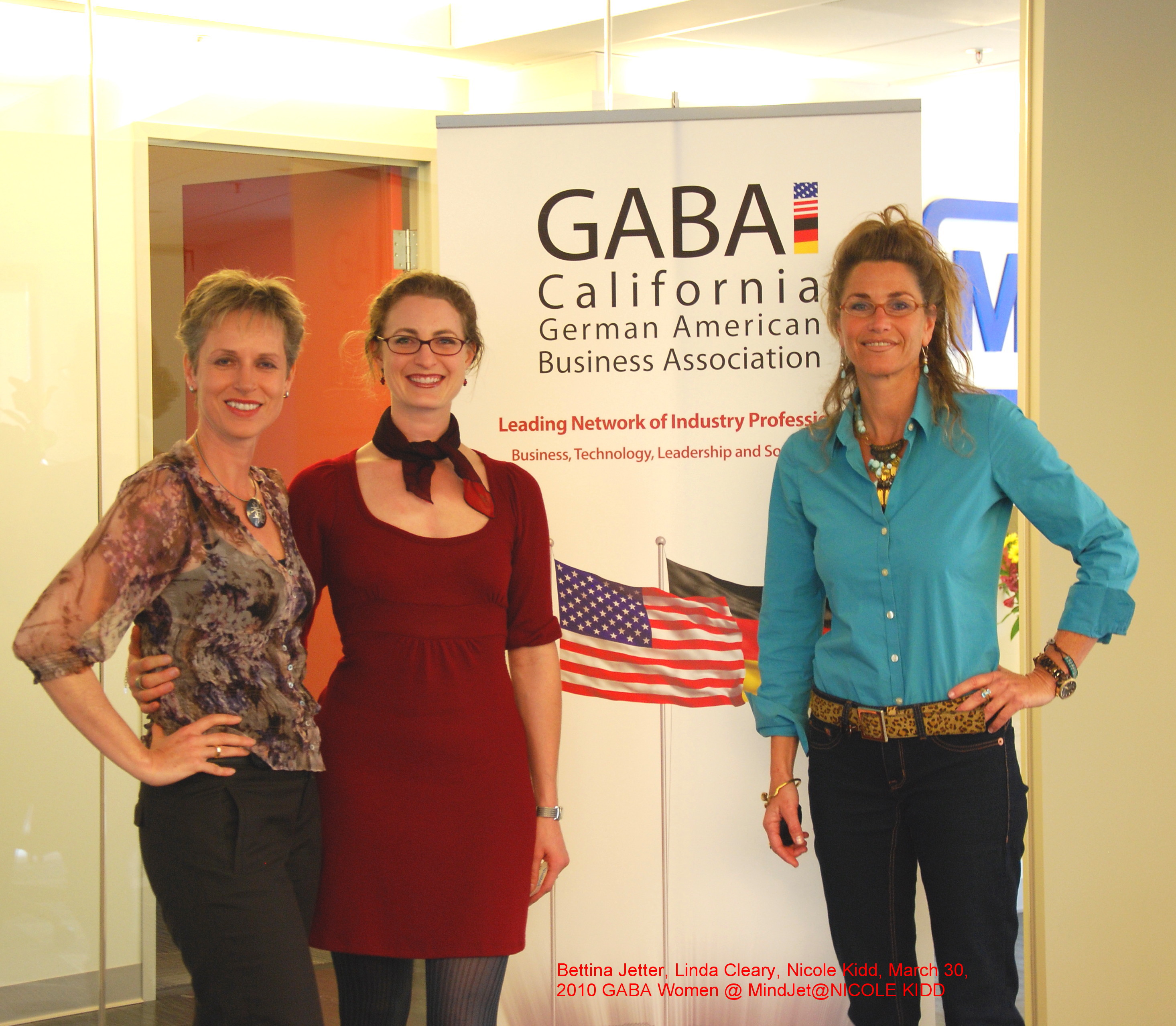
On March 30th, over 50 women came to the Mindjet office in San Francisco to discuss how social media marketing can become a viral instrument to turn your unique experiences into a successful business.
It was our most marketed event yet— promoted on four different social media networks (along with our usual email channels), inspired the group’s first-ever real-time Tweets, and lots of email group activity about the topic.
Our speakers got the conversation started by sharing their personal and professional experiences about using social media for their start-up business, within larger organizations, and on behalf of their clients:
Bettina Jetter – serial entrepreneur and founder of Coaching Sanctuary
Chaszey-Sandhriel-Dejay - Executive Director of Pay It Forward Academy
Betsy Streeter - Cartoonist/Illustrator/Designer/Teaching Artist
Nicole Kidd - Rebmann Research U.S. Trend Scout & Analyst
Bettina, Linda and Nicole
The discussion explored how women excel at networking, business persona versus personal personas, and the social media business bottom line. Comments about marketing techniques quickly turned to questions about how to market using social media, and the realization that social media more than just a marketing trend— it’s a business reality and a social imperative.
Some noteworthy sound bites:
Social media has shot to the forefront of people's attention because it is fun. Thanks to social media, it's easy to share your ideas, photos, videos, likes and dislikes, with the world at large - and find out what they think of them. You can find friends, business contacts and become part of a community or a bunch of different communities. Social media allows you to connect with people you have something in common with, and it helps to streamline the process who you meet.
Set goals, be authentic, know your values before you create your profile.
Make wise decision whether you want to give your product or services away for free. However, generosity oftentimes pays off because it can raise awareness and catches someone’s interest.
You may want to consider using software that helps you to manage your time, increase productivity and to stay focused. Remember that it is easy to get lost. Pace yourself and follow the 80/20 rule.
A Joint SAP/Churchill Club/GABA Panel Discussion at SAP Labs in Palo Alto, April 13
Last night I had the pleasure of opening another panel discussion on Cloud Computing. This time the panel was part of SAP’s Virtualization Week 2010 and moderated by Rachel Chalmers, Research Director at “the 451 group”, an independent technology-industry analyst company focused on the business of enterprise IT innovation. On the panel we had executives from SAP, Citrix, T-Systems, and AT&T Business Solutions.
I remember that in 2005 I had organized the first panel for GABA on a similar topic, only that at the time we called it Adaptive or Utility Computing and not Cloud Computing. Obviously Cloud Computing seems to be a more popular term and I wonder who started it. Was it Salesforce.com or Google or Amazon? It was definitely not SAP, they just adopted this term because it seems to be more than just another buzzword du jour.
The lively discussion about cloud related issues like security, bandwidth, certifications, cloud standards and others made very clear that Cloud Computing for enterprises, especially Cloud Computing for SAP, is not the kind of Cloud Computing we are all familiar with from Google. Who cares what happens with your data, when your Google search command ends up in a public cloud. All we care about is a precise answer in a timely manner. And although this requirement may also be true for any SAP user, you want to make sure that your data stays in the country and is secure at any time. But is data more vulnerable when it resides in a cloud rather than in your own data center? Our panelists seem to think that there is no perfect security solution and there will always be somebody trying to break though your fire wall.
However, companies like AT&T and Deutsche Telekom (T-Systems’ mother ship) are not only investing millions of dollars into more bandwidth, but also in high-security data centers. The buyer’s expectation is to lower the cost of ownership, increase ease of consumption and fast time to value.
Under Rachel’s excellent moderation, panelists discussed the shift from on premise to on demand computing, and from upfront to as needed consumption of compute power: Customers want flexibility even if it is only a hybrid approach to Cloud Computing, e.g. keeping core applications in-house and sending edge applications into the cloud. Another good first step for companies to experience the cost savings and agility of Cloud Computing would be using the cloud for their batch processes or peek situations. Large corporations offering HR Self Services to their employees during the Open Enrollment period at the end of the year, utilities sending out millions of invoices at the end of each month, e-commerce retailers coping with Back to School or Holiday Season demands... these are all opportunities for Cloud Computing
What I personally took home from this event is that Cloud Computing is no longer just a hype – it is reality. It may not yet be perfect, but it is a great way of lowering a company’s total cost of ownership coming with agility and better performance. I know that this will not be the last panel discussion on Cloud Computing for GABA. The mid-market customer is expecting SaaS Software-as-a-Service, where a user wouldn’t have any upfront investments but only pay what he uses - SAP from tap, so to speak. Stay tuned.
We are in the early stages of the Social Networking revolution. It may seem that this revolution started recently with sites like LinkedIn, Facebook, and Twitter. In fact, the revolution started initially in the dotcom era with dating sites (match.com, yahoo personals…) and reconnection sites (classmates.com, Ancestry.com…). These sites, all of which I have used in the past, laid the foundation for the Social Networking revolution we are experiencing today.
It simple to join any Social Network and many times “free.” It seems like all you need to do is add the required information and you are part of the network. Do not be deceived by the simplicity; there is much more thought that needs to go into what you say and what you add to your Social Networks.
Many people see Social Networking as another fad that will fall apart over time or something they do not need to understand because it will not affect the way they do business or even a big waste of time. Wrong! In 2008, 22% of employers used Social Networking to do background checks. By 2010, the projection is over 55% will be using Social networking for background checks. I believe that the estimate is conservative.
From the perspective of a job searcher, Social Networks make it easier for potential employees to research companies and potential bosses. Reading the recommendations or lack thereof tells you a lot about a person and gives you “interesting” information on their management style or lack thereof. You do not know who your friend’s friend’s friend is and what they do. If you are looking for a job, it is imperative that you utilize Social Networking, both in person and on the web. Your competition, for any posted job is already using both methods. Additionally, there are techniques to use Social Networking to project where a new job might be.
When I received the email request to do a guest blog for GABA, I was both honored and wondered who was making this request. As a Social Networking expert, I like to know as much as I can about the person I am talking with. I immediately looked up the GABA project manager on Linkedin, Facebook, Twitter, and Xing. It turns out that she is a third-degree connection on LinkedIn and I have 11 connections that are connected to someone who knows her. If I wanted, I could have requested an introduction through LinkedIn or called one of my 11 connections to see if they knew her directly and requested a "warm" introduction. My experience is many people do not convert their second- and third-degree connections to first-degree connections.
I look forward to discussing how “Social Networking - Increases Your Personal & HR Opportunities!” on September 10, 2009 with you. If you are attending, please take quick the on-line survey (10 minutes). GABA will send you the link after you register. Thanks, I look forward to talking with you at the workshop.
Alliance-Strategies policy is to link with only people we know professionally on both LinkedIn and Xing. As for Facebook and Twitter, these are wide open.






 Sincerely,
 Posts
Posts


